
Connecticut weather does not give much warning. A nor’easter that drops two feet of heavy wet snow can materialize over a weekend in March. A summer thunderstorm line can push through New London County in forty minutes and leave broken trees across three towns. The properties that come through those events without significant damage are almost never lucky. They are usually properties where someone paid attention to the trees ahead of time.
Storm preparation for trees is not complicated, but it does require actually doing it before the storm, not while it is happening or after the damage is done. This is a practical guide for Ledyard homeowners and property owners throughout southeastern Connecticut on what tree preparation actually involves and when it needs to happen.
Why Southeastern Connecticut Trees Are Particularly Vulnerable
A few things about this region make storm-related tree failure more common here than in drier or colder climates.
Nor’easters bring wet, heavy snow, not the dry powder that falls further north and inland. Wet snow sticks to branches and packs on. A single large limb can accumulate hundreds of pounds of snow load within hours of a storm starting. The branches most likely to fail under that weight are the ones that were already compromised, dead, or structurally weak going into the season.
The tree canopy in this part of Connecticut is heavily influenced by decades of emerald ash borer damage. Most ash trees in southeastern Connecticut are dead or dying, and dead ash becomes brittle fast. A dead ash that looked stable in October can be genuinely dangerous by February, and by the following summer it is a serious hazard. Properties with standing dead ash need to address it before storm season, not after.
Clay soils throughout much of New London County hold water and drain slowly. A week of heavy fall rain followed by a windstorm creates saturated, softened soil that cannot anchor roots the way dry or well-drained soil can. Trees that would hold in normal conditions can uproot when the ground is waterlogged and the wind is pushing.
The Most Important Thing You Can Do: Get the Dead Wood Out
If you do nothing else to prepare your trees for storm season, remove the dead wood. This is not a hedge or a suggestion. Dead branches are structurally unreliable in a way that live wood simply is not. Live wood bends under load. Dead wood breaks. In a nor’easter or a summer thunderstorm with 60 to 70 mph gusts, the dead limbs in your tree canopy are the ones coming down. The question is just whether they come down during a controlled removal or during the storm, onto whatever is underneath them.
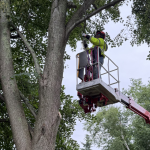
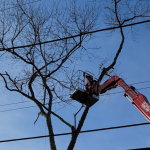
The service arborists call this crown cleaning, and it is the single highest-value storm preparation work you can have done. It removes the dead, dying, and broken wood from the canopy while leaving the live structure intact. A properly crown-cleaned tree going into storm season is a meaningfully safer tree than one that has not been touched.
The International Society of Arboriculture publishes best management practices for pruning that define what proper dead wood removal looks like and distinguish it from the kind of aggressive over-pruning that actually harms trees. Worth reading if you want to understand the difference before hiring anyone for the work.
What Else to Look For Before Storm Season
Crown cleaning is the priority, but a proper pre-storm inspection covers more than just dead wood. Here is what to evaluate on any large tree near a structure before the weather gets serious:
Co-dominant stems
Many large trees in older southeastern Connecticut neighborhoods developed two or more main trunks from the same base. Where those trunks meet, there is often a V-shaped union with bark growing inward between them. That configuration is structurally weaker than a single trunk, and under heavy snow or wind load, it is a common failure point. A tree with a co-dominant stem that is directly over a structure should be evaluated for cabling before it fails.
Overextended laterals
Long, heavy branches that have grown significantly beyond the canopy edge put substantial leverage load on their attachment point. Under ice or snow, that load multiplies fast. If you have a large limb extending well past the main canopy and hanging over the roof or the driveway, it is worth having the weight reduced through proper pruning before winter.
Cracks at major unions
Cracks at branch attachments or in the main trunk that were not there last season are a signal that something is changing structurally. Not all cracks mean immediate failure, but any crack deep enough to see into on a tree near a structure deserves a professional look before a significant storm puts additional load on that spot.
Root zone concerns
Check the soil around the base of large trees after any period of heavy rain. Heaving or cracked soil, a slight new lean that was not there before, or exposed roots pulling out of the ground on one side are all signs that the root system is compromised and the tree is less stable than it looks from above.
The Myth of Storm Pruning
One of the most persistent misconceptions about tree preparation is that stripping as much canopy as possible before a storm reduces the risk. The logic seems reasonable: less canopy means less surface area for wind to push against. The problem is that it does not work that way.
A properly structured tree canopy distributes wind load across multiple branches and limbs, each of which flexes and absorbs energy. When you strip that canopy heavily, the remaining branches carry the full wind load without the structure to distribute it, and those branches are often the largest and most significant ones. Over-pruned trees fail in storms at higher rates than properly maintained trees, not lower ones.
The Connecticut Agricultural Experiment Station has published guidance on tree care that addresses this directly. The goal of pre-storm pruning is targeted removal of specific hazards, not general canopy reduction.
What proper pre-storm pruning removes: dead wood, hanging limbs, branches with visible cracks or decay at the attachment point, and weight from overextended laterals where the load is genuinely excessive. What it does not do: strip the canopy, remove healthy live branches without a structural reason, or top the tree.
Timing: When Should This Work Happen?
For most of the work described above, late summer through fall is the practical window for southeastern Connecticut homeowners. The reasons:
- Trees are still in leaf, which makes it easier to see which sections of the canopy are genuinely dead versus just slower to come out versus the rest of the tree.
- You are ahead of nor’easter season and the heavy wet snow events that typically start in November and December.
- Fall is also when many homeowners are doing other yard work and notices trees that need attention while they are spending time outside.
For oaks specifically, timing matters for a different reason. Oak wilt, a vascular disease active in Connecticut, spreads through wounds during the growing season when the beetles that carry it are most active. Pruning oaks between April and October creates fresh wounds that attract those beetles. Pruning oaks in late fall or winter, once the beetles are not active, is the correct timing for that species.
Emergency hazard removal, meaning dead limbs over structures, active leans, hanging widow-makers, is a different category. Those situations do not wait for the right season. If the hazard is present now, the work should happen now.
Dead Ash Trees: A Specific Concern in This Region
Emerald ash borer has killed the large majority of ash trees across Connecticut over the past two decades, and southeastern Connecticut is not an exception. Many properties in Ledyard, Stonington, Waterford, East Lyme, and the surrounding communities still have standing dead ash that the homeowner has not dealt with yet.
Dead ash is a specific storm hazard because of how quickly the wood deteriorates after the tree dies. Ash wood becomes brittle much faster than oak or maple, and the bark sloughs off in sheets, making the tree progressively harder and more dangerous to climb as time passes. A dead ash that has been standing for two or three years is genuinely hazardous to remove, not just a routine job.
If you have dead or dying ash on your property, dealing with it before storm season is not optional. A standing dead ash in a windstorm fails unpredictably and can take down whatever is nearby.
After the Storm: What to Do and What Not to Do
If a storm does cause damage despite your preparation:
- Photograph the damage from multiple angles before anything is touched, especially if you plan to file an insurance claim.
- Stay away from anything in contact with a power line. Call Eversource to report it and wait for confirmation that the line is safe before approaching.
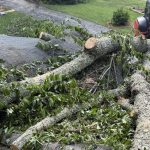
- Do not try to cut a tree off your house yourself. Storm-damaged trees carry stored tension in the wood that releases violently when the wrong cut is made. This is the most common source of serious chainsaw injuries following major storms in New England.
- Hanging limbs that did not fully fall during the storm, widow-makers still attached in the canopy, are sometimes more dangerous than the limbs that came all the way down. Do not walk under them while waiting for a crew.
The National Weather Service office for southern New England provides forecasts and storm watches for southeastern Connecticut. Bookmarking it before storm season is a practical step that costs nothing.
Get Your Trees Evaluated Before Storm Season
H&H Tree Service has been preparing trees across Ledyard, Gales Ferry, Mystic, Stonington, Waterford, East Lyme, and Old Lyme for storm season for 30 years. Free on-site consultations for any property in southeastern Connecticut. We walk the property, identify the specific hazards on your trees, and tell you what work makes sense before something forces the issue.